

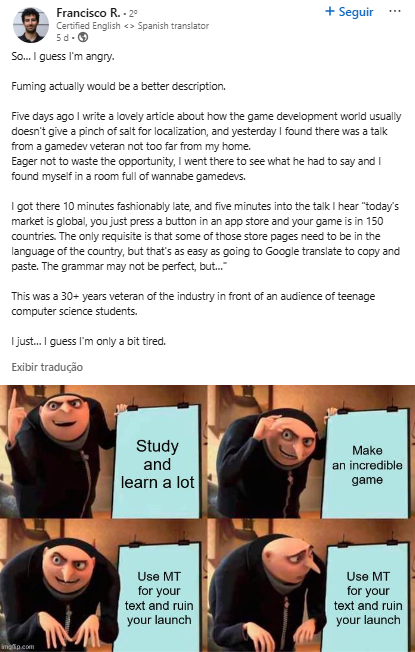
I recently found a very interesting post on LinkedIn from a game translator who attended a game dev event and heard a controversial affirmation about the future of localization in games.
It got applause. Of course it did. It sounds like progress. It sounds like scale. It sounds like the problem is solved. But there’s a quieter question sitting underneath that moment. No one asked it.
Translation Is No Longer the Barrier
Let’s be clear about something. The shift is real. Machine translation works. LLMs are improving. And they will continue to improve. This is not a debate anymore.
If your goal is to make your game understandable in multiple languages, you can do that today. Instantly. That changes everything.
Because translation is no longer the bottleneck. Decision-making is.
If Everything Can Be Translated, What Should Be?
A few years ago, localization was limited by cost. Now it’s limited by strategy.
If you can translate your game into 150 languages, the real question becomes:
- Which languages actually matter for your game?
- Which ones will generate players, not just installs?
- Which ones deserve refinement instead of raw output?
Because not all languages bring the same value. And not all players behave the same way.
Steam Already Gave You the Answer
One of the most overlooked tools in the industry is Steam’s review analytics by language.
It tells you something simple, but powerful: Where your players are actually engaging.
Not where they downloaded. Where they cared enough to leave feedback. That’s your signal. Not guesses. Not assumptions. Not “let’s translate everything.”
If a language is generating reviews, it’s generating experience. And experience is where localization starts to matter.
.png)
The Real Problem Is Not Translation. It’s Experience
A machine can translate your UI. It can translate your dialogue. It can even translate your store page. But it cannot guarantee that the experience makes sense. Because games are not made of sentences.
They are made of:
- systems
- tone
- consistency
- immersion
If a character sounds different in every scene, something breaks. If a mechanic is described differently across menus, something breaks. If your tone shifts between updates, something breaks.
Not visibly. But perceptibly. And players feel it.
The Smart Path: Low Cost, High Gain
So what does a smarter approach look like? Not “translate everything perfectly.” Not “ignore localization entirely.” Something in between. A system.
Start with machine translation. Yes. But don’t stop there.
Layer it.
- Identify your key markets (using real data, not assumptions)
- Focus human review where impact is highest (store pages, core UX, narrative)
- Use automation for long-tail content
- Maintain consistency through glossary and memory
This is where cost becomes controlled. And value becomes intentional.
The Real Challenge: Maintenance
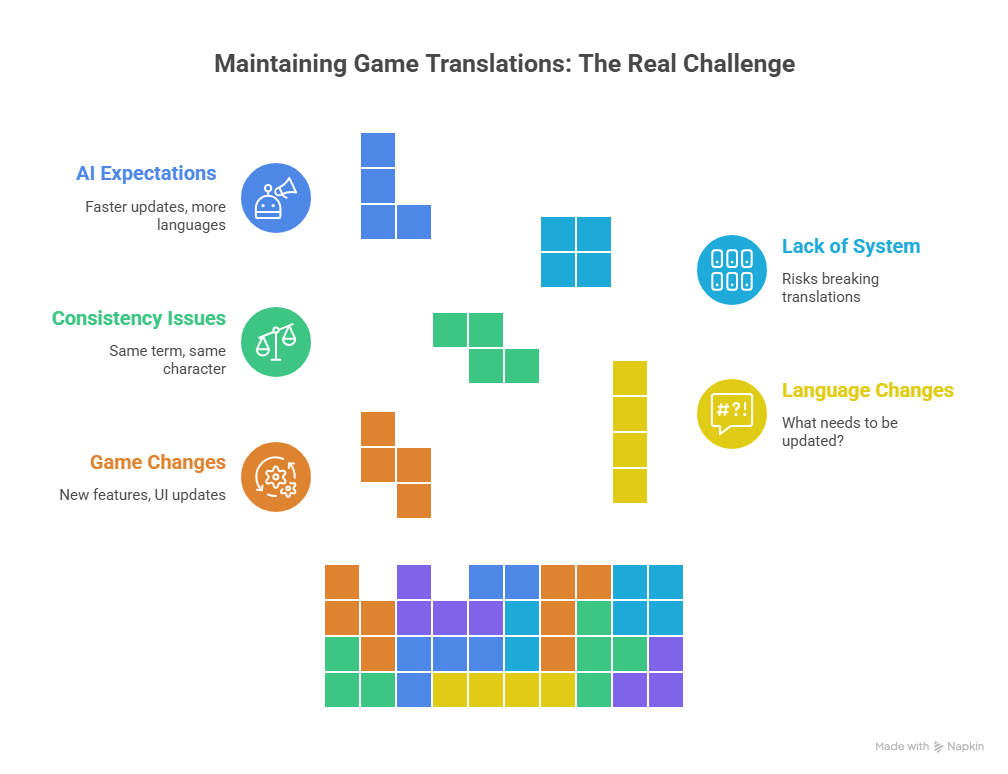
Shipping translations is easy. Maintaining them is not.
Your game changes.
- new features
- updated UI
- rewritten text
- live ops content
Now ask yourself:
- What changed across languages?
- What needs to be updated?
- What should stay consistent?
Without a system, every update risks breaking something. Not because the translation was bad. But because it wasn’t connected.
Consistency Is the Invisible Multiplier
The biggest difference between a translated game and a localized game is not accuracy. It’s consistency.
The same term means the same thing everywhere. The same character sounds the same throughout. The same experience feels coherent across updates.
This doesn’t happen by accident. It happens when language is treated as a system. Even a simple glossary can dramatically reduce risk.
When combined with translation memory and context-aware workflows, you stop translating line by line. You start building continuity.
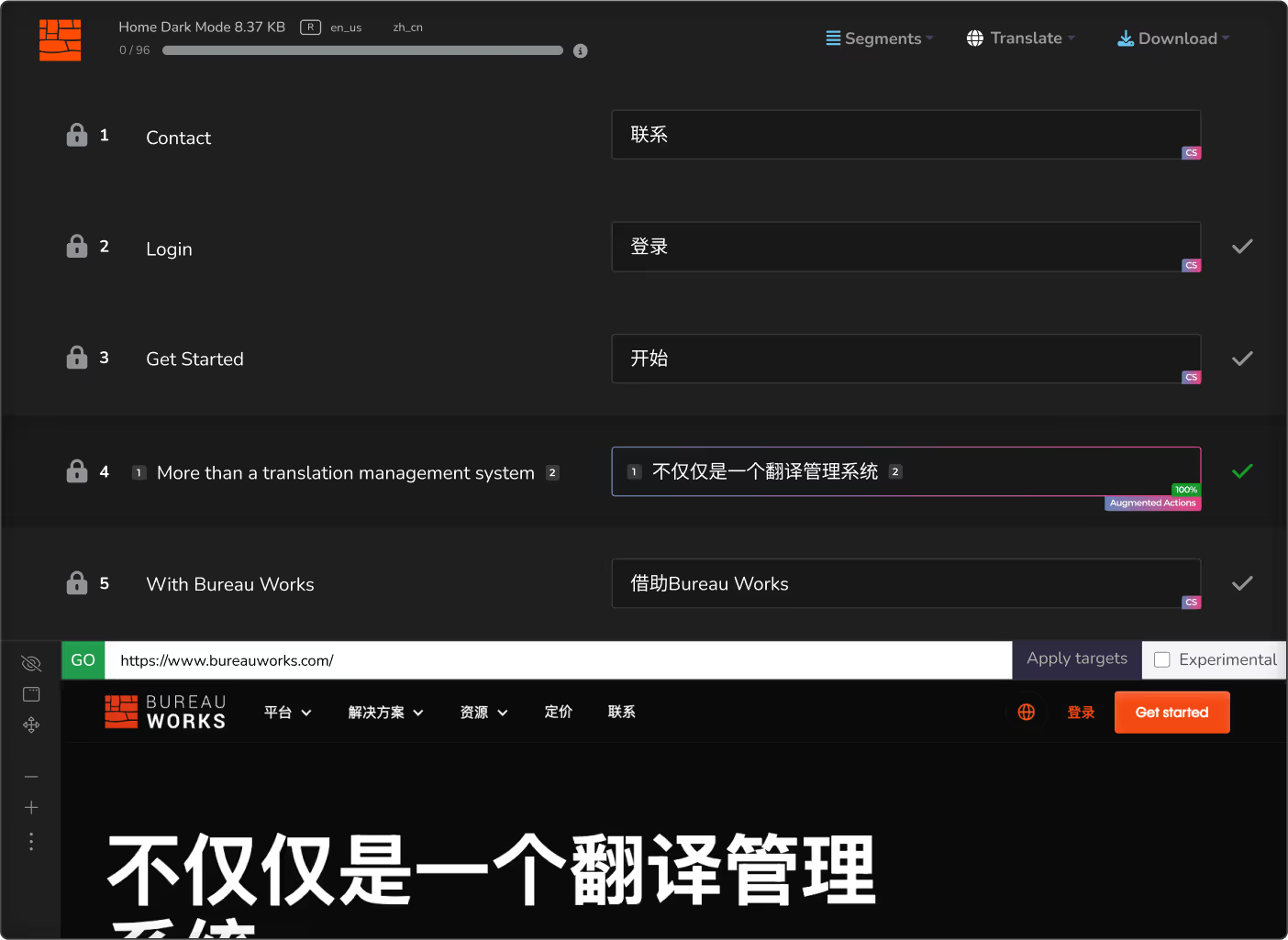
This is where platforms like Bureau Works come into play, not as translation tools, but as systems that help teams maintain consistency across languages while still leveraging automation.
AI Didn’t Kill Localization. It Raised the Bar
There’s a fear that AI replaces translators. That’s not what’s happening. AI removed friction. And when friction disappears, expectations rise.
Players now expect:
- faster updates
- more languages
- consistent quality
The bar didn’t go down. It went up. And meeting that bar requires more than just output. It requires structure.
The Question You Should Be Asking
Not: “Should I use AI for translation?”
But: “How do I use it without breaking my game across languages?”
That’s the real problem. And it’s a much more interesting one.
If you’re building a game and thinking about reaching players across languages, the goal is not just to translate more.
It’s to translate intelligently.
Bureau Works helps game teams combine AI translation with structured workflows, glossary management, and consistency control, so you can scale globally without losing the integrity of your game.
👉 Create your account and start building a localization system that grows with your game.
Unlock the power of glocalization with our Translation Management System.
Unlock the power of
with our Translation Management System.