

If you’ve been trying to get freelance translation work lately, you’re probably feeling something strange: you’re doing more than ever, and getting less back.
You apply to jobs, send proposals, update your profile, refine your pitch… and still feel invisible.
This isn’t just your imagination. And it isn’t just you.
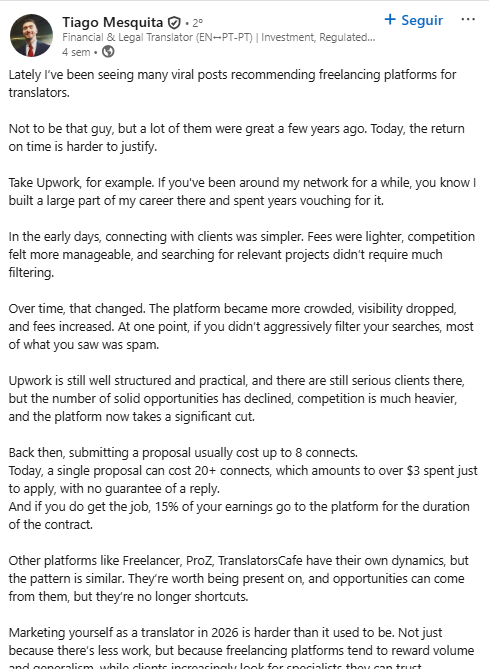
People on LinkedIn captured something many translators have been thinking quietly for a while: the freelance platforms that once felt like a shortcut (Upwork, ProZ, Freelancer, TranslatorsCafe) are now crowded, noisy, and harder to justify.
Not because they stopped working completely. But because the return on effort changed. A lot.
The platforms didn’t “get worse.” They got saturated.
A few years ago, freelance platforms felt more navigable. Competition existed, but it was manageable. Fees were lower. Spam was lower. The odds of finding real opportunities were higher.
Today, the platforms still have serious clients, but they also have a lot more of everything else: more freelancers, more bots, more low-quality job posts, more generic proposals, more price pressure.
The platform became more crowded, visibility dropped, and fees increased.
And that matches what most freelancers are experiencing. It’s not that there are no jobs. It’s that the system is now designed in a way that rewards volume and speed.
And translation is not a volume-and-speed craft. At least not if you want to build a career.
Generalists get swallowed. Specialists get remembered.
Platforms tend to work better for generalists than for specialists.
That sounds unfair at first, but it makes sense. If your pitch is “I can translate anything,” you can compete in more listings. You can apply faster. You can play the volume game.
But if your pitch is “I translate regulated medical content for EN > PT,” you are playing a different game. A slower one. A deeper one.
And that’s the point.
Specialists don’t win by applying more. They win by being easier to trust.
When a client is hiring for something sensitive like: legal, medical, financial, brand-heavy, they don’t want “a translator.” They want a safe choice.
The more specific you are, the easier it becomes for a client to say: “This person is for us.”
The real competition is not other translators. It’s sameness.
Most proposals look identical.
They start with the same polite sentence. They include the same vague promise. They list the same generic skills. They feel like they were copied and pasted.
That’s not because translators are lazy. It’s because platforms push everyone toward the same behavior. The system rewards fast replies, not thoughtful ones.
But here’s the uncomfortable truth: if your proposal feels like a template, the client will treat you like a commodity.
And commodities are always replaced.
If you want to stand out, you have to be human in a place that is trying to turn everyone into a button.

If you want better jobs, stop selling “translation”
This is one of the hardest mindset shifts.
Most translators market themselves as translators.
But clients aren’t buying “translation.” They are buying outcomes.
They are buying clarity, trust, reduced risk, brand consistency and speed without chaos.
So instead of pitching yourself as “a translator,” pitch yourself as:
- someone who helps fintech teams stay compliant across markets
- someone who helps SaaS products sound natural in Brazil
- someone who helps e-commerce brands localize faster without breaking tone
- someone who helps law firms avoid ambiguity in multilingual contracts
Translation is the tool. The job is bigger.
When your pitch matches the client’s world, you stop competing with everyone. You start competing with almost no one.
Humanized proposals beat perfect proposals
Most freelancers try to improve their proposals by making them more “professional.”
More polished. More formal. More correct.
But the problem isn’t professionalism. The problem is distance.
If you want to get chosen, you need to reduce uncertainty. And the fastest way to reduce uncertainty is to feel real.
One simple tactic: send a short Loom video or audio message introducing yourself. Not a performance. Not a monologue. Just 30–60 seconds explaining:
- who you are
- what you specialize in
- one relevant example
- why you’re a safe choice
This does something powerful. It makes you harder to ignore. In a world full of generic text, a human voice is a signal.
And yes, it feels uncomfortable at first. But discomfort is often a sign you’re leaving the crowd.

Stop applying everywhere. Start targeting companies who actually need you.
Here’s another shift that feels obvious, but most freelancers avoid it because it requires initiative.
Instead of searching for jobs, search for companies.
If you translate EN > PT-BR, you already know which industries are expanding into Brazil. You know which companies are hiring. You know which products are being launched. You know where localization is not optional.
So build a small list of companies that match your niche. Then send a human, customized message.
Not a “Dear Sir/Madam” template.
A real note.
Something like:
- “I noticed your product is expanding in LATAM.”
- “Your UI and onboarding flow are strong, but your Portuguese reads like machine output.”
- “If you want, I can help you scale in Brazil without losing your voice.”
This isn’t begging. This is positioning.
You are not asking for a job. You are offering clarity. And in most companies, clarity is rare.
The best freelancers are not hired. They are trusted.
A lot of freelancers are still operating with the mindset of: “I need to get hired.”
But freelancers who survive long-term operate differently: “I need to build trust.”
Trust is built through consistency, not perfection.
It comes from:
- showing up on time
- communicating clearly
- delivering clean work
- asking smart questions
- understanding the client’s context
- not overpromising
When you build trust, clients stop shopping. They stop comparing you to cheaper options. They stop treating you like a line item.
They keep you.
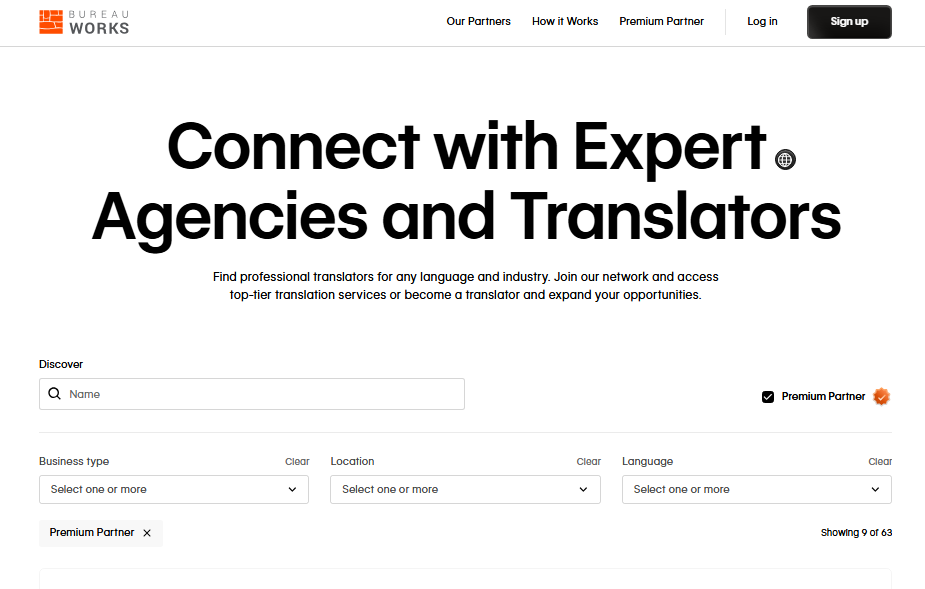
Where to find those companies?
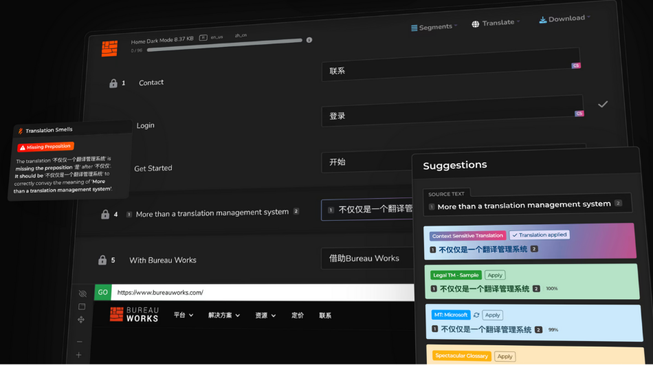
At Bureau Works, we work with language professionals every day. We see that same pattern all the time: specialists leaving the big freelance platforms and moving toward direct relationships, long-term partnerships, and clients who value expertise.
But we also know something else. Most translators don’t need “more gigs.” They need better pathways into serious work.
That’s why Bureau Works offers a freelance ecosystem where translators can connect with companies and teams that care about quality, context, and long-term collaboration. Not just speed and price.
It’s not about competing in a noisy marketplace. It’s about working in a system where your specialization is actually an advantage.
The market didn’t end. It evolved.
If you’re struggling right now, don’t assume you’re failing. The market is changing. The platforms are changing. The incentives are changing. And translators who adapt will still win.
Not by sending more proposals. Not by working cheaper. Not by being faster than the next person. But by being clearer.
More specific. More human. More intentional. That’s what makes you hard to replace.
Want a better way to connect with real translation work?
If you’re a translator looking for opportunities that respect your craft, take a look at Bureau Works.
Our platform connects language professionals with companies that need quality translation at scale, without turning translators into anonymous profiles fighting for scraps.
Explore Bureau Works and join the freelance ecosystem.If you’re good at what you do, you shouldn’t have to shout to be seen.
Unlock the power of glocalization with our Translation Management System.
Unlock the power of
with our Translation Management System.