

The translation industry has always had a strange problem.
It is everywhere, but rarely visible. It powers global commerce, yet it often gets treated like a “nice-to-have.”
And now, in the age of generative AI, this old contradiction is becoming louder.
In a recent debate hosted by Gabriel Fairman, two of the most influential voices in the language industry sat down to discuss a discrepancy of nearly $40–50 billion.
On one side: Renato Beninatto, co-founder of Nimdzi Insights, arguing the industry is closer to $75.7B.
On the other: Florian Faes, co-founder of Slator, defending a more conservative estimate around $31.4B.
The funny part? They didn’t actually disagree that much.
But the difference in their numbers reveals something deeper: we are not arguing about math, we are arguing about meaning.
Why This Debate Matters More Than the Numbers
Gabriel opens the discussion with a killer framing:
“We are not here to check your math. We’re here to check your logic.”
And that’s the key. Because market size is never just a number. It becomes a psychological map.
If you believe the industry is $30B, you behave differently than if you believe it is $75B.
- Investors allocate differently
- Startups pitch differently
- CEOs plan differently
- Freelancers and agencies feel differently about the future
And in a moment as unstable as 2026, how you interpret the map shapes what you build next.

Renato’s View: Language as a Utility (and a Hidden Economy)
Renato’s logic is simple, but bold:
Translation is not only what LSPs invoice. Translation is everything society spends to make communication work across languages.
So when Renato estimates a $75B market, he’s counting:
- outsourced translation revenue
- government translation budgets
- in-house translators inside enterprises
- interpreting ecosystems
- hidden companies nobody tracks
- and even machine translation spend by Big Tech
He gives a concrete example:
“Brussels spends close to three billion euros in translation only.”
He also highlights how translation is not just a service market, it is a budget market.
Even if a company isn’t paying an LSP, it might still be paying:
- Microsoft
- Alibaba
- AI providers
- internal teams
- enterprise MT contracts
In Renato’s world, the industry is massive, not because it is one neat sector, but because it is a distributed necessity.
Florian’s View: TAM Must Be Addressable (Or It Becomes “Ghost Money”)
Florian’s stance is not pessimistic. It is disciplined. He argues that the “Total Addressable Market” must be winnable by companies in the language industry.
If translation spend happens inside Google Docs or YouTube, Florian does not count it, not because it isn’t real, but because it is not realistically addressable by LSPs or language platforms.
Florian explains that Slator expanded their estimate from ~$25B to $31.4B specifically because AI is blurring boundaries.
They now include:
- language conversion
- mode conversion (speech ↔ text)
- language generation
But they still exclude:
- subcontracting cascades (LSI → LSI)
- Big Tech translation features
- foundation model spend
- data labeling services
In Florian’s words, they want the “A” in TAM to mean something.
“We have a market figure that is addressable.”
This is not a debate about optimism vs pessimism. It is a debate about what counts as a real market versus what counts as a broader economic footprint.

The Real Question: Is Translation a Market… or an Infrastructure?
This is the hidden philosophical layer in the conversation.
Renato treats translation like electricity: it’s not optional, and it exists everywhere.
Florian treats translation like a sector: a defined ecosystem with buyers, sellers, and competitive boundaries.
And both are correct. Translation is becoming infrastructure and staying a market. That’s why this debate is so valuable.
Because it forces the industry to ask:
What is translation in 2026?
Is it:
- a service you buy
- a feature inside products
- a layer inside AI systems
- a risk mitigation function
- or a mode of human communication?
The answer is: yes. And that’s why the numbers are diverging.
Growth vs Pressure: Two Emotional Maps of the Same Reality
One of the most interesting moments in the debate is when Gabriel admits something personal.
He says that when he listens to Florian, he feels pressure. When he listens to Renato, he feels optimism. And that’s not random.
Florian’s world is about:
- margin squeeze
- efficiency replacing service revenue
- tech eating old workflows
- pockets of growth + pockets of destruction
Renato’s world is about:
- new buyers
- new platforms
- more languages
- more content
- more formats
- and translation expanding wherever communication expands
Florian responds with something important:
“There’s a ton of winning going on out there.”
So the industry isn’t collapsing. It is reorganizing. And reorganizations always feel like collapse to the people who built their identity around the old structure.
The Three Growth Vectors That Make Translation Weirdly Resilient
Renato offers one of the strongest frameworks in the entire debate:
Translation grows through three different vectors:
- more content volume
- more languages
- more platforms / formats
This matters because it means translation isn’t just tied to “globalization.” It is tied to the very way modern humans communicate.
A single idea now exists in:
- a blog post
- a TikTok
- a podcast
- a webinar
- subtitles
- dubbing
- UI microcopy
- product onboarding
- legal compliance
- and internal knowledge bases
Same message. Different modes. Different translation needs. That is why translation refuses to die.

The Most Important Shift: From Scarcity to Coordination and Risk
One of the most insightful parts comes later, when Florian explains what AI is actually doing to value.
Historically, language services were built on scarcity:
- the right translator
- at the right time
- in the right language pair
- with the right specialization
AI reduces that scarcity dramatically. But the value doesn’t disappear. It moves. Florian argues that value shifts toward:
1) Coordination
Getting content from point A to point B in the right format, with the right workflow, with the right stakeholders.
2) Integration
Connecting localization with the systems that produce content: CMS, product, support, video, marketing, compliance.
3) Risk mitigation
Ensuring quality and compliance in:
- healthcare
- life sciences
- legal
- finance
- defense
This is the part that can’t be solved by “good enough.”
Because “good enough” is still a lawsuit.
Why Per-Word Pricing Is Starting to Break
Renato makes a prediction many people in localization are already feeling: The word will remain a unit of currency, but it will no longer be the main one.
Both Renato and Florian agree:
- prompt engineering is not a major billable service
- per-word pricing will coexist, but weaken
- the industry is shifting toward outcomes
Renato’s final advice is one of those lines that feels like it should be printed:
“Move away from output and talk about outcomes.”
That’s the future.
Not “how many words did you translate?” But “what did this enable?”
The Industry Is Not Shrinking. It Is Splitting.
This might be the most important takeaway.
The translation industry is not one thing anymore.
It is splitting into two worlds:
World 1: Translation as a service market
This is where LSPs, agencies, freelancers, and managed services compete.
This world feels squeezed.
World 2: Translation as a communication layer
This is where platforms, AI tools, Big Tech, and multimodal features expand.
This world feels explosive.
Both worlds are real.
And they are growing in opposite emotional directions.
That’s why people feel confused.
The Two Best Pieces of Advice in the Entire Debate
The debate ends with each participant giving a “word of wisdom.”
And honestly, they are perfect opposites , in a good way.
Renato’s advice: focus on why
Stop selling translation as a process.
Start selling translation as meaning, purpose, and business value.
Florian’s advice: get hands-on
Spend one hour a day using language AI tools.
Because without hands-on exposure, you fall into two traps:
- “It’s all hype.”
- “I’ll be replaced tomorrow.”
Neither is true.
But both are emotionally seductive.

Final Thought: The Future of Translation Is Not a Line. It’s a Cone
Renato says something subtle but powerful: He prefers to model the future as a cone, not a straight line.
Because the industry grows:
- in different directions
- at different speeds
- with different definitions
- depending on who is measuring it
That’s not a weakness. That’s a sign translation is becoming what it always wanted to be: not a niche industry, but a layer of civilization.
Want to see where this industry is going from the inside?
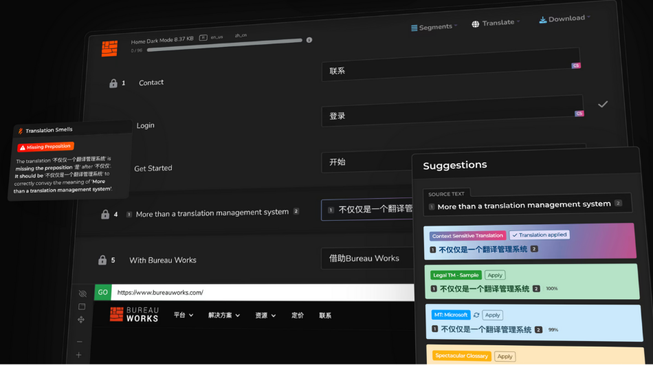
At Bureau Works, we build tools that live in that intersection: where AI makes translation faster, but humans stay in control.
If you’re curious about what translation becomes when it’s treated like infrastructure, not just a service, sign up for Bureau Works and explore the platform.
Because in 2026, the question isn’t whether translation is $30B or $75B.
The real question is:
What will you build when language stops being a barrier?
Unlock the power of glocalization with our Translation Management System.
Unlock the power of
with our Translation Management System.