

There is a disease spreading in the tech world. It sounds sophisticated. It feels futuristic. It uses words like agentic, autonomous, self-operating.
And it quietly replaces one word with another. Agency.
We look at an AI agent and think: It decides. It thinks. It doesn’t need me. That belief is not only wrong. It’s dangerous. Because autonomy is not agency.
And confusing the two is how humans slowly give away authorship without noticing.
Vanilson Burégio made a very interesting ana
This perspective isn’t theoretical. It builds on a technical paper by Vanilson Burégio, Bureau Works’ Director of Software Engineering, who mapped out how agentic AI workflows actually function in practice.
His work shows that performance gains don’t come from “smarter” models alone, but from structured loops, task decomposition, and reflection layers that make outputs reliable over time.
In other words, the breakthrough isn’t intelligence. It’s architecture.
Autonomy Is a Setting. Agency Is Ownership.
In engineering terms, an AI agent is a system that executes multiple steps to complete a task.
It researches. It drafts. It revises. It cross-checks. That’s autonomy. But agency (real agency), is something else entirely.
Agency is ownership over action. It is the reason the task exists in the first place. It is intent. An AI system can execute a process. It cannot care about the outcome.
That difference is everything.
The Slot Machine Illusion
Most people use AI like a casino. You type a prompt. You pull the lever. You hope for a jackpot. A perfect translation. A perfect strategy. A perfect paragraph.
This is what engineers call single-shot prompting. It’s gambling.
And the tech industry has turned prompt-writing into a competitive sport. “Here are the best prompts.” “Here’s how to get the perfect answer in one try.”
But real work doesn’t happen in one try. It happens in loops.
Process Beats Intelligence
There’s a benchmark that says more than any headline.
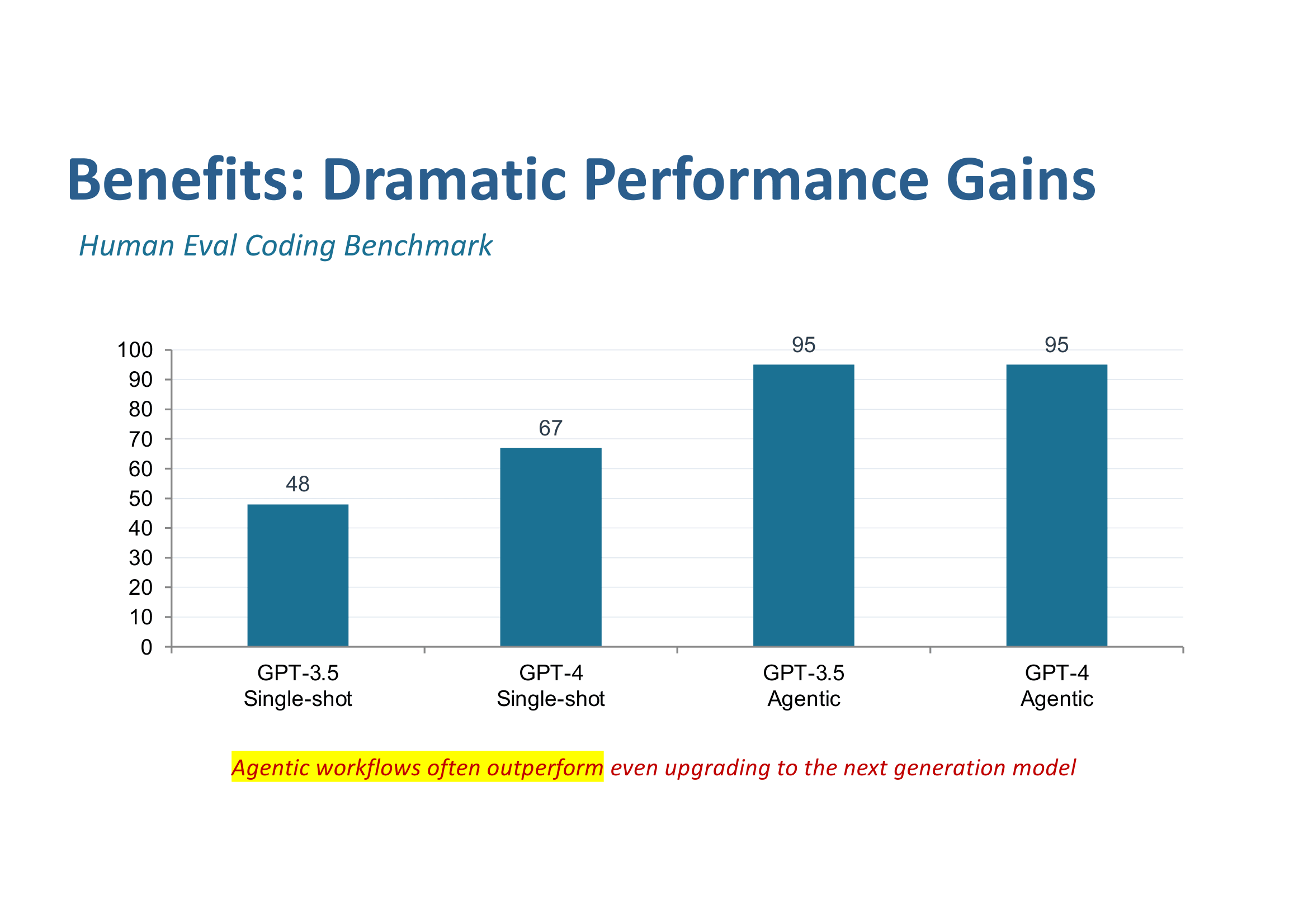
A “smarter” model using single-shot prompting scored 67%. A “less advanced” model using an agentic loop scored 95%.
Let that sink in. The dumber model won. Why?
Because it worked inside a process. It generated. It critiqued. It revised. It reflected.
Raw intelligence lost to architecture. And that breaks the myth that we’re just waiting for GPT-6 or GPT-7 to replace us. We’re not waiting for smarter models.
We need better systems.
In Localization, This Difference Is Brutal
If you tell a model: “Translate this legal contract.”
That’s not innovation. That’s negligence. Even if you add glossary instructions, tone guidance, reference files, it’s still single-shot thinking.
Real localization requires decomposition.
- Extract context.
- Identify ambiguities.
- Draft.
- Critique terminology.
- Review tone.
- Check consistency.
- Reflect.
This is where tools like Translation Smells come in. Not to score language. But to question it.
“Tone too formal.” “Potential gender bias.” “Inconsistent terminology.”
The machine can flag. It cannot decide. And that decision, whether something is wrong or intentional, belongs to the human.
The Architect, The Auditor, The Creator
The future doesn’t belong to people who “use AI.” It belongs to three types of humans:
Architects
They design workflows. They break big problems into solvable steps.
Auditors
They verify. They define what “good” means. They manage reflection.
Creators
They build skills. Modular procedural knowledge. They encode how things should be done.
If you don’t define the skill, the agent is just a chatbot. If you do define the skill, the agent becomes an extension of your intent. We are not using AI. We are equipping it.
Autonomy Is a Spectrum. Agency Is Not.
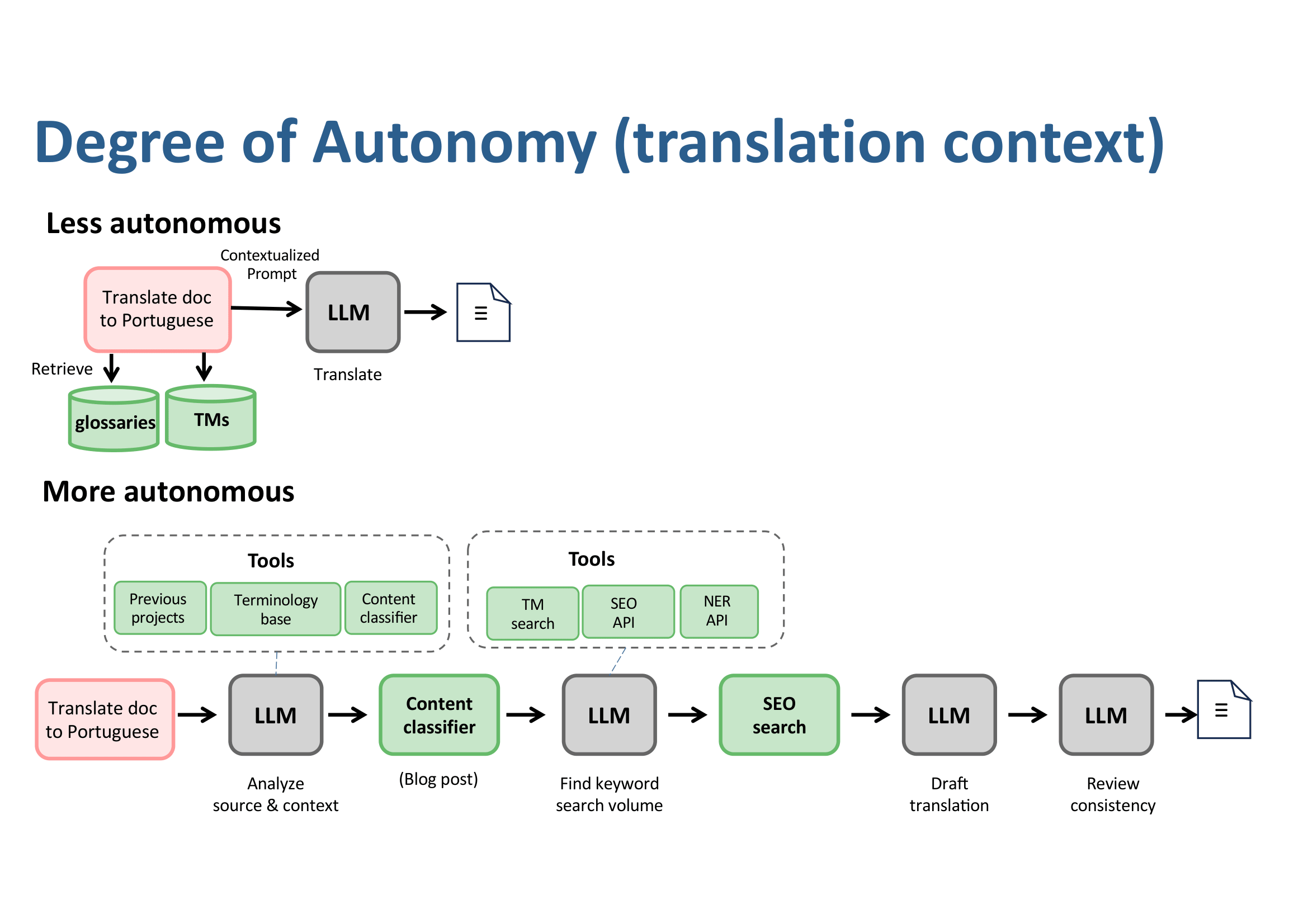
An agent can have low autonomy: Follow fixed steps.
Or high autonomy: Adapt dynamically, search alternatives, optimize routes.
But nowhere does autonomy become intent. The machine can process. Retrieve. Revise. It cannot care. And caring is not a small feature.
It is the foundation of responsibility.
The Real Shift in 2026
The fear that “agents will replace us” comes from vocabulary confusion. Autonomy is just tool complexity. Agency is authorship. And authorship is human.
The real shift is not that machines are getting smarter. It’s that humans must get more intentional. You don’t fight automation by resisting it. You fight it by architecting it. Build the loop.
Design the reflection. Define the skill.
Break the machine before it breaks your authorship. Because the future doesn’t belong to autonomous systems. It belongs to the people who design them.
Want to stop gambling on single-shot prompts?
Bureau Works helps you build reliable, agentic workflows for translation and localization, so AI works inside a process, not outside it.
Book a demo and see how “skills + reflection + human auditing” improves quality at scale.
Unlock the power of glocalization with our Translation Management System.
Unlock the power of
with our Translation Management System.