

Video used to be visual. Now it’s linguistic.
Scroll through Instagram. Open YouTube. Watch a product demo. You’ll see auto-generated captions. AI dubbing. Subtitles in five languages. Sometimes a button that says “Audio Track: Spanish.”
Something changed. Video is no longer just content. It’s infrastructure.
And if you’re not localizing it, you’re quietly choosing who gets included, and who doesn’t.

Why localized video suddenly matters so much
There was a time when translating a website felt enough.
Today, attention lives in video.
Product tutorials. Webinars. Reels. Ads. Customer onboarding. Support walkthroughs.
If your product scales globally but your video doesn’t, you create friction. And friction kills momentum.
Localized video matters for three reasons:
- Reach – Algorithms reward watch time. People watch longer when they understand.
- Trust – Hearing your language builds psychological safety.
- Conversion – Comprehension increases action.
It’s not about being “inclusive” as a slogan. It’s about being understandable.
And understandable brands grow faster.
Subtitles are not enough (but they are a start)
Most platforms now auto-generate subtitles. That’s progress. But subtitles alone don’t solve localization.
Automatic captions:
- often miss tone
- misunderstand brand terms
- struggle with technical vocabulary
- ignore cultural nuance
They give you access. They don’t give you authorship. And the difference matters. If your brand voice is careful, precise, or emotionally specific, bad subtitles don’t just reduce clarity.
They distort identity.
Dubbing is growing. But control still matters.
AI dubbing tools are improving rapidly.
YouTube now offers multi-language audio tracks. Instagram experiments with voice cloning. AI can generate synthetic voices that sound almost human.
This is powerful. But here’s the uncomfortable question: Who controls the terminology? Who ensures the tone matches the market? Who makes sure your compliance language stays compliant? Who guarantees that your playful marketing video doesn’t become awkward in another culture?
Speed without governance creates drift. And drift erodes brand value.
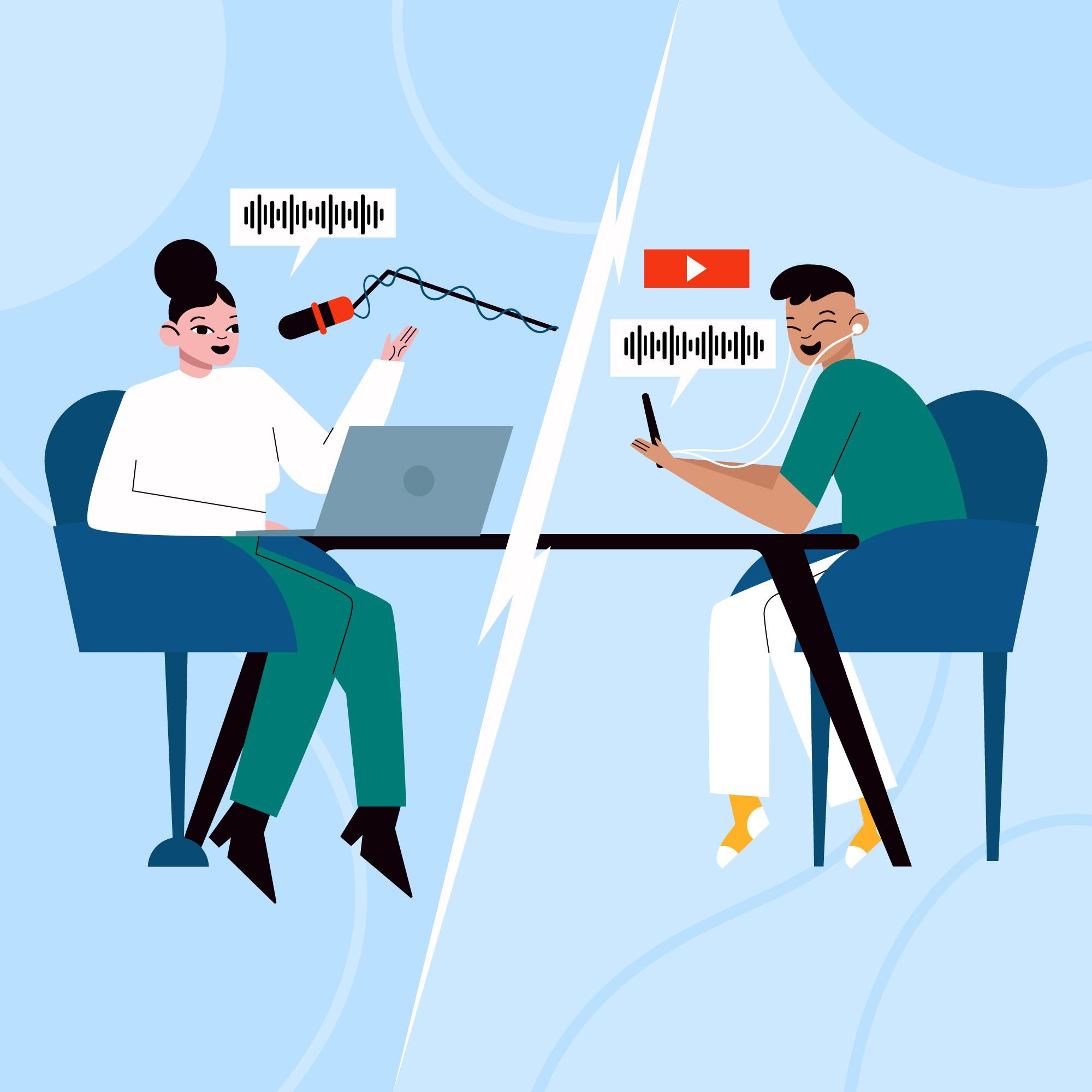
Localized video is not about translation. It’s about continuity.
Video localization touches multiple layers:
- transcription
- subtitle timing
- translation
- terminology alignment
- tone adaptation
- voiceover generation
- review
- version control
And it doesn’t end after publishing. Language evolves. Messaging changes. Features update. Legal requirements shift.
If your localization process is fragmented, one tool for subtitles, another for translation, another for voiceover. You lose continuity.
And continuity is what keeps a global brand feeling like one brand.
The real risk: scaling content without scaling memory
Generative AI made it easy to produce video content. Now companies are publishing faster than ever.
More tutorials. More announcements. More explainers.
But when you localize that volume without a centralized language system, small inconsistencies multiply:
A term translated one way in one video, differently in another. A slogan adapted once, ignored later. A feature renamed in one market but not updated in others.
Localized video isn’t just media production. It’s linguistic governance at scale.
The tools that make localized video possible
Today, the ecosystem looks something like this:
- Social platforms with auto-captions
- AI dubbing services
- Standalone subtitle generators
- Machine translation tools
- Voice cloning software
They all solve pieces of the problem. But few solve the system.
What serious brands need is:
- centralized terminology
- translation memory
- contextual awareness
- review workflows
- version tracking
- multimodal support (text, audio, video)
- scalability across repositories
Because video is not isolated from your website, support center, or product UI. It’s part of your language ecosystem.
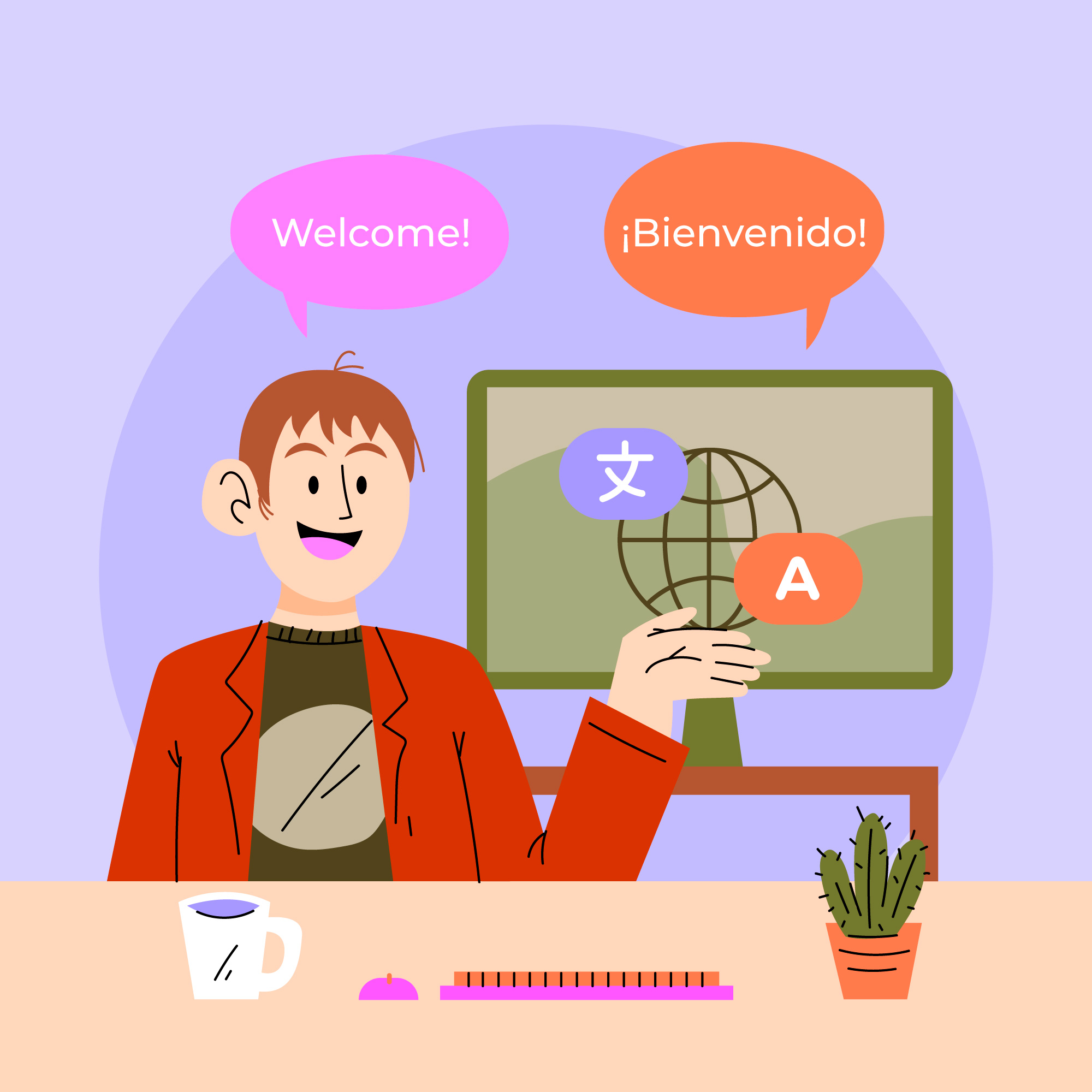
A multimodal platform that solves all at once
At Bureau Works, we don’t see localized video as a “media feature.” We see it as language infrastructure.
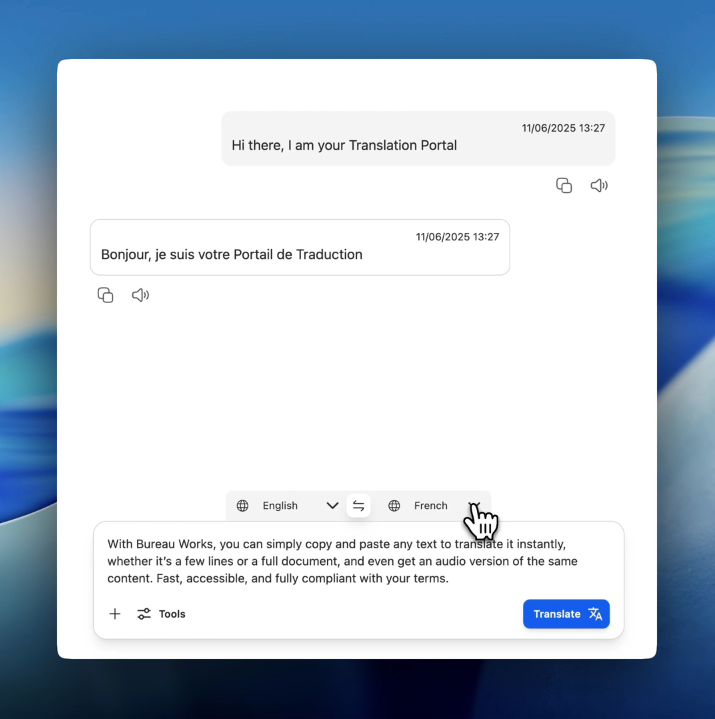
With the Translation Portal, you can:
- Upload a video
- Automatically generate subtitles (.srt files)
- Edit them in a contextual translation environment
- Apply your terminology
- Convert text to speech
- Manage human review when needed
- Keep everything connected to your broader linguistic memory
The important part isn’t that subtitles are generated instantly. The important part is that they don’t exist in isolation.
They connect to your translation memory. They respect your terminology. They evolve with your brand.
Speed matters. But continuity matters more.
The future of video is multilingual by default
We are entering a phase where monolingual video feels incomplete. Consumers expect options. They expect to understand. And they expect brands to speak clearly, not just loudly.
Localized video is not about chasing every language. It’s about deciding that if you communicate, you communicate responsibly.
Because when someone hears your message in their language, it’s not just comprehension. It’s recognition. And recognition builds loyalty.
If you’re producing video at scale and still managing localization through scattered tools, it may be time to rethink the system.
Bureau Works helps teams localize video with control, memory, and governance. Not just automation.
Unlock the power of glocalization with our Translation Management System.
Unlock the power of
with our Translation Management System.