

It’s 2026.
Generative AI is no longer a novelty. It’s infrastructure. Contentful, Adobe Experience Manager, Drupal, and countless other CMS platforms now offer “translation” as a built-in feature. You click a button and your website appears in five languages.
And honestly? It’s impressive.
If you compare it to what machine translation looked like ten years ago, the difference is dramatic. Large language models in the loop produce translations that are often surprisingly good. For small brands testing new markets, this feels like magic.
Which leads to the inevitable executive question:
If translation is now a feature…
why do we still need a translation management system?
The answer is uncomfortable.
Because speed is not the same thing as scalability. And translation is not just output. It’s governance.
The First Version Is Easy. The Fifth Version Is Not.
Translation as a feature works beautifully on day one.
You translate your website. You publish. You feel global.
But language is not static. It is alive. It changes the moment customers interact with it.
Imagine you launch in Brazil and a customer says: “This sounds strange.” So someone on your team tweaks a phrase. Maybe “Get Started Now” becomes something more formal. Maybe a tone feels too casual. Maybe a product description needs cultural adjustment.
That change doesn’t live in isolation.
It influences the voice of your brand. It impacts future translations. It shapes expectations.
Now ask the harder question: where does that change live?
If you are translating directly inside a CMS using translation as a feature, those edits often stay local. The string changes, but the broader knowledge base does not. The model doesn’t learn from that decision in a structured way. The correction doesn’t necessarily propagate across systems.
You start creating small fractures in your linguistic universe.
And over time, those fractures multiply.
Language Is a System, Not a Set of Strings
One of the most misunderstood aspects of translation is that it isn’t about isolated sentences. It’s about a living corpus.
Every word choice affects the next one. Every terminology update changes future outputs. Every tone adjustment shapes the way the brand feels in that market.
If you modify a key term and add it to a term base inside a proper translation management system, that decision influences future translations. It becomes part of the DNA of your brand voice in that language.
But if you edit directly inside different platforms ike Contentful here, Zendesk there, Intercom somewhere else, you create linguistic silos. Each repository evolves independently.
Now imagine managing that across ten languages.
Scalability doesn’t collapse dramatically. It erodes quietly.
Governance Is Invisible Until It Breaks
Translation as a feature is seductive because it removes friction. No integrations. No extra platforms. Just click and go.
But what happens when you start involving reviewers?
Where are edits stored?
Who tracks version control?
How do you measure the impact of terminology changes?
How do you ensure that your website voice matches your support center voice and your marketing collateral voice?
Think about how companies handle copywriters. They rarely hire one for the website, another for email campaigns, and a third for product descriptions without oversight. There’s usually a marketing team ensuring consistency.
Now multiply that complexity across languages and cultures.
Without centralized governance, tone drifts. Terminology fragments. Brand coherence weakens.
And once your brand voice fractures internationally, rebuilding it is far more expensive than managing it correctly from the start.
Control Is More Than Tone Sliders
Some CMS translation features allow light control: adjust tone, add reference material, tweak preferences. That’s useful. But it’s coarse.
Language decisions are often microscopic.
Sometimes a brand chooses to sound more formal in one context but slightly informal in another. Sometimes a legal exception overrides the general rule. Sometimes a cultural nuance demands a deviation from the norm.
Where do those exceptions live?
How are they contextualized?
Without a centralized linguistic knowledge base, those decisions become scattered human memory instead of institutional memory.
And institutional memory is what allows brands to scale without losing identity.
Small Brands Can Start Simple. Big Brands Cannot Stay There.
Translation as a feature is fantastic for proof of concept. For startups exploring new markets. For testing discoverability.
It lowers the barrier to entry for globalization. That’s a good thing.
But once a brand gains visibility, once it builds a customer base, once its voice carries weight, the risks multiply.
Now you are not just translating for discoverability.
You are translating to protect trust.
And trust requires control.

AI Raises the Bar. It Doesn’t Lower It.
There’s a common fear that generative AI will eliminate the need for structured translation systems. That it will make everything automatic.
But something else is happening.
Because AI makes it easier to produce content, the baseline quality expectation rises. Consumers are becoming more sensitive to tone, coherence, and authenticity. They recognize generic messaging. They reject “AI slop.”
The easier it becomes to generate content, the more valuable ownership becomes.
And ownership requires tools built for precision.
Gabriel used a powerful metaphor: performing complex surgery with a butcher knife instead of a scalpel. Even the best surgeon struggles with the wrong instrument.
Large language models are powerful. They are transformative.
But without the right management system around them, they are blunt.
This Is Not the End of TMS. It’s the Beginning of Its Evolution.
Translation as a feature is not a threat. It’s an entry point. It accelerates globalization for small teams. It enables experimentation. It reduces friction.
But once language becomes strategic, once it shapes brand perception, compliance, support, and community, you need structure.
You need a centralized knowledge base. You need governance. You need memory. You need control.
Not because AI failed. But because language matters.
And when language matters, someone has to own it.
Translation as a feature is easy.
Ownership is not.
If you’re serious about scaling globally without losing control of your voice, your terminology, and your governance, you need more than a button inside a CMS.
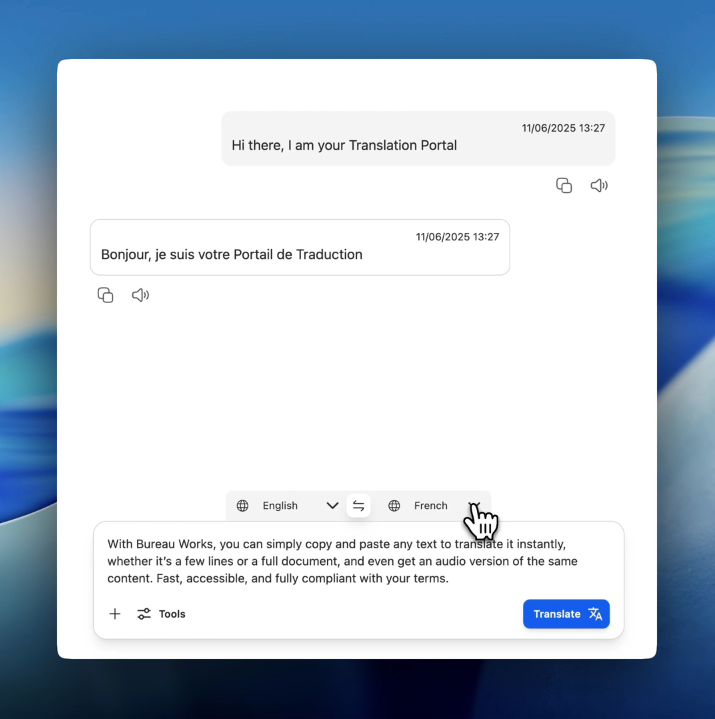
Sign into Bureau Works and experience what centralized language control actually feels like.
AI can move fast.
Your brand still needs direction.
Unlock the power of glocalization with our Translation Management System.
Unlock the power of
with our Translation Management System.





.avif)