

Chinese Vocabulary Is Like Lego: Building Infinite Meanings with Limited Pieces


Hello, Chinese learners!
If you've ever played with Lego blocks, you know that simple pieces can transform into castles, spaceships, or entire cities. Chinese works in much the same way: basic characters combine to form complex words, and understanding these combinations is the key to mastering vocabulary intelligently, without relying solely on mechanical memorization.
Whether you're learning simplified or traditional Chinese characters, the fundamental logic of word formation remains the same. Understanding the differences between these writing systems can help you choose the right path for your learning goals.
Why is word formation so important?
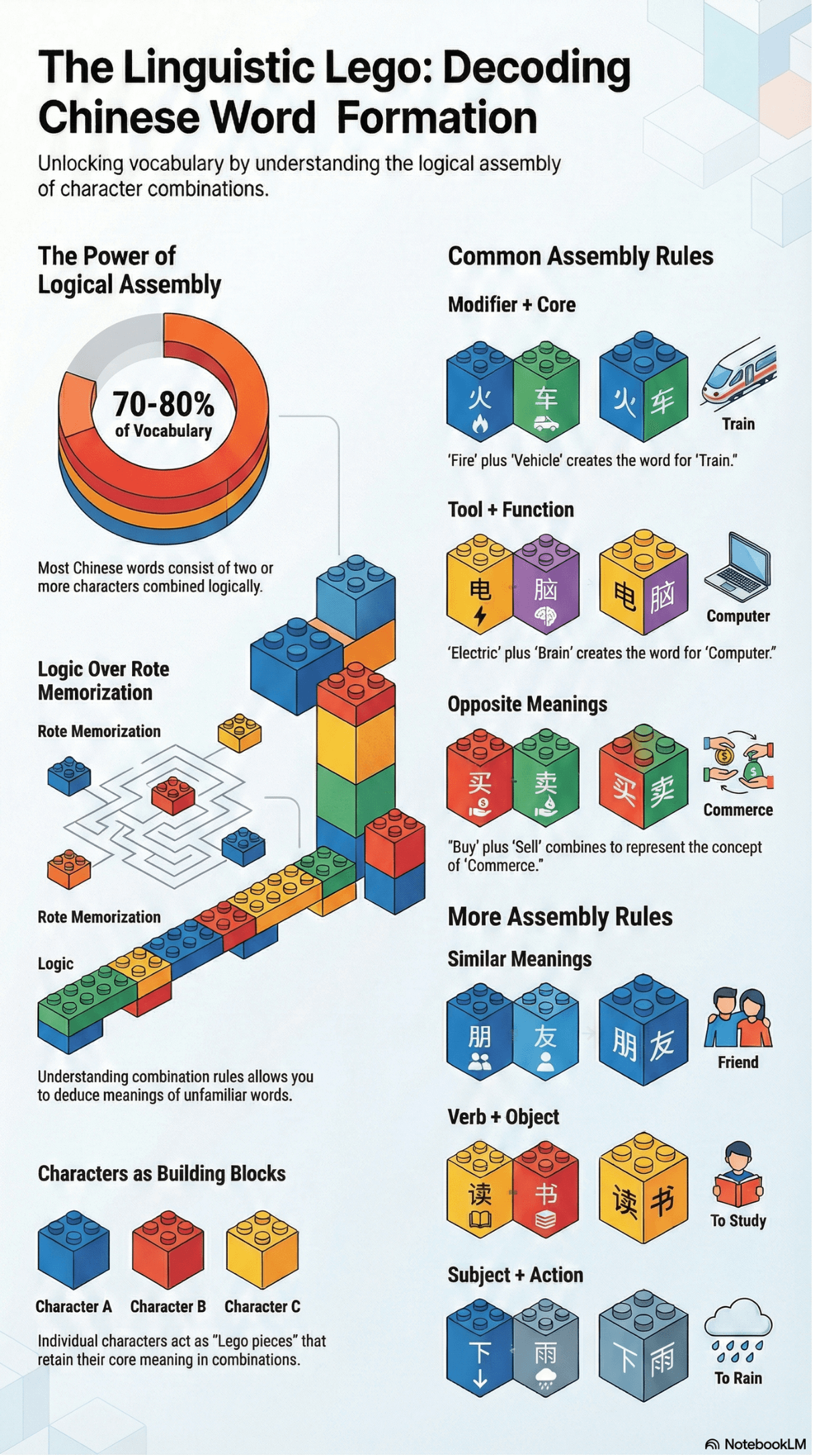
In Portuguese, we often learn new words as isolated units. In Chinese, however, most words (about 70-80%) are composed of two or more characters, and these characters generally retain part of their original meaning. This means that by knowing the combination rules, you can:
- Deduce the meaning of words you've never seen before
- Memorize with logic instead of pure repetition
- Understand the culture and history behind concepts
The "assembly rules" of Chinese
Just as Lego has different ways to fit pieces together, Chinese has recurring patterns of word formation. Let's explore some of them with practical examples and cultural stories that bring them to life:
.svg)
1. Modifier + Core
One character functions as an adjective or specifier, and the other as a noun.
Example: 火车 (huǒchē) = train. 火 means fire and 车 means vehicle. In the past, trains were steam-powered, hence the idea of "fire vehicle." Another example is 绿茶 (lǜchá), literally "green tea." You'll find this pattern in cultural symbols too, like 龙 (lóng - dragon), a character that carries deep meaning in Chinese culture and appears in countless compound words.
2. Verb + Object
Here we have an action accompanied by what it affects.
Example: 读书 (dúshū) = to study, literally "read book." 吃饭 (chīfàn) = to eat, literally "eat rice/meal."
3. Similar Meanings
Two characters with related senses unite to reinforce the idea.
Example: 朋友 (péngyou) = friend. Both 朋 and 友 meant "companion" in ancient texts. Another example is 城市 (chéngshì), which combines 城 (city wall) and 市 (market), forming the notion of "city." This compound structure appears throughout Chinese culture, including in celebrations like Chinese New Year, where traditional practices combine ancient meanings with modern festivities.
4. Opposite Meanings
Two contrasting characters join together to express a comprehensive concept.
Example: 买卖 (mǎimài) = commerce, literally "buy and sell." 大小 (dàxiǎo) = size, uniting big and small.
5. Subject + Action
One character indicates who or what acts, and the other describes the action.
Example: 下雨 (xiàyǔ) = to rain, literally "descend rain."
6. Tool + Function
One character indicates the means or instrument, and the other the action or result.
Example: 电话 (diànhuà) = telephone, literally "electric speech." 电脑 (diànnǎo) = computer, literally "electric brain."
How to apply this in your studies
When you encounter a new two-character word, pause and ask yourself:
- Do I already know each character separately?
- What's the logical relationship between them? Is it like adjective + noun? Action + object? Opposition?
- Does the meaning make sense in context?
For example, when you see 电影 (diànyǐng) = film, you can analyze: 电 = electricity/light, 影 = shadow/image. Together, "luminous image" → film.
Practical tips for turning vocabulary into a logic game
Choose some basic characters, like 水 (water), 人 (person), 心 (heart).
.svg)
Combine them with others you already know. For example:
- 水果 (shuǐguǒ) = fruit, literally "water product"
- 人口 (rénkǒu) = population, literally "people's mouths"
- 心情 (xīnqíng) = mood, literally "heart's feeling"
.svg)
This exercise shows how each combination opens a new window of meaning.
Conclusion
Thinking of Chinese vocabulary as Lego transforms learning into a logical and fascinating puzzle. Instead of memorizing endless lists, you start to see patterns, stories, and connections. Each character is a piece, each formation rule is an instruction manual, and fluency is the incredible construction you'll build with creativity and discipline.
Remember: learning Chinese isn't just about accumulating words, but discovering how they fit together to reveal the logic and culture of an ancient language. A culture rich with traditions that have evolved over millennia.
Happy studying! 加油!(Jiāyóu! = Let's go!)
Unlock the power of glocalization with our Translation Management System.
Unlock the power of
with our Translation Management System.





.avif)
.avif)

.avif)
.avif)
.avif)