

Thank you for your support. This month, we shipped two updates. The one you’re reading now is our regular monthly update, and we also published a special year recap with everything from the year in a nutshell, which you can access here.
But before we talk about what we shipped, it’s worth stepping back for a second.
Translation has been around for more than 5,000 years.
It started as a tool to run multilingual empires like Mesopotamia and Egypt. Serious stuff. Legal contracts, tax records, official announcements. Some of the oldest examples we have are Sumerian texts translated into Akkadian over 5,000 years ago. Wild, right?
And for most of history, the way translators worked stayed remarkably consistent. The source text and the translation lived side by side. Translators constantly compared meaning, tone, and intent. That way of working lasted for thousands of years.sdf
Then the 1980s arrived. Computers showed up. And suddenly everything was sliced into segments.
Did everyone love that? Not really. Many translators still worked with split screens and full text editors whenever they could. But for large organizations, cost reduction was more important. Segmentation won.
So for nearly half a century in a 5,000 year history, translators have worked sentence by sentence. Segments brought reuse and consistency, sure. But did anyone ever ask translators if this was the best way to work?
That’s why we built Free Flow.
It removes segments, keeps modern tools like glossaries and past translations, and lets translators work the way they always have. In full context. Without breaking the content.
FREE-FLOW
For decades, translators had to choose between a good writing experience and the power of translation tools. Free Flow brings both together. It keeps the document whole, so you work in full context with tone, rhythm, and structure intact, instead of translating sentence by sentence and rebuilding meaning in your head.
Built on vectors, not segments, Free Flow focuses on meaning.
It uses semantic search to apply memories and glossaries based on intent, not string matches. The system learns from your edits, adapts to how you work, and supports literal or creative translation without forcing rigid structures. It’s a translation editor designed for how language actually works, today and what comes next.
Translation Pipelines
How do you compete in an AI world? A world where, for many companies, LLM translation is already “good enough”?
Here’s the ironic part. Even with massive automation, you still need… automation. Your automation. You know what it actually takes to deliver a good project. So you need to turn your recipe into rules that work the same way, every time.
You know things like:
- When a project can safely skip a step in the workflow.
- Who should review a project before delivery.
- Who needs to be notified, and in which situations.
- And honestly, the list of controls can go on forever.
That’s where Pipelines come in.
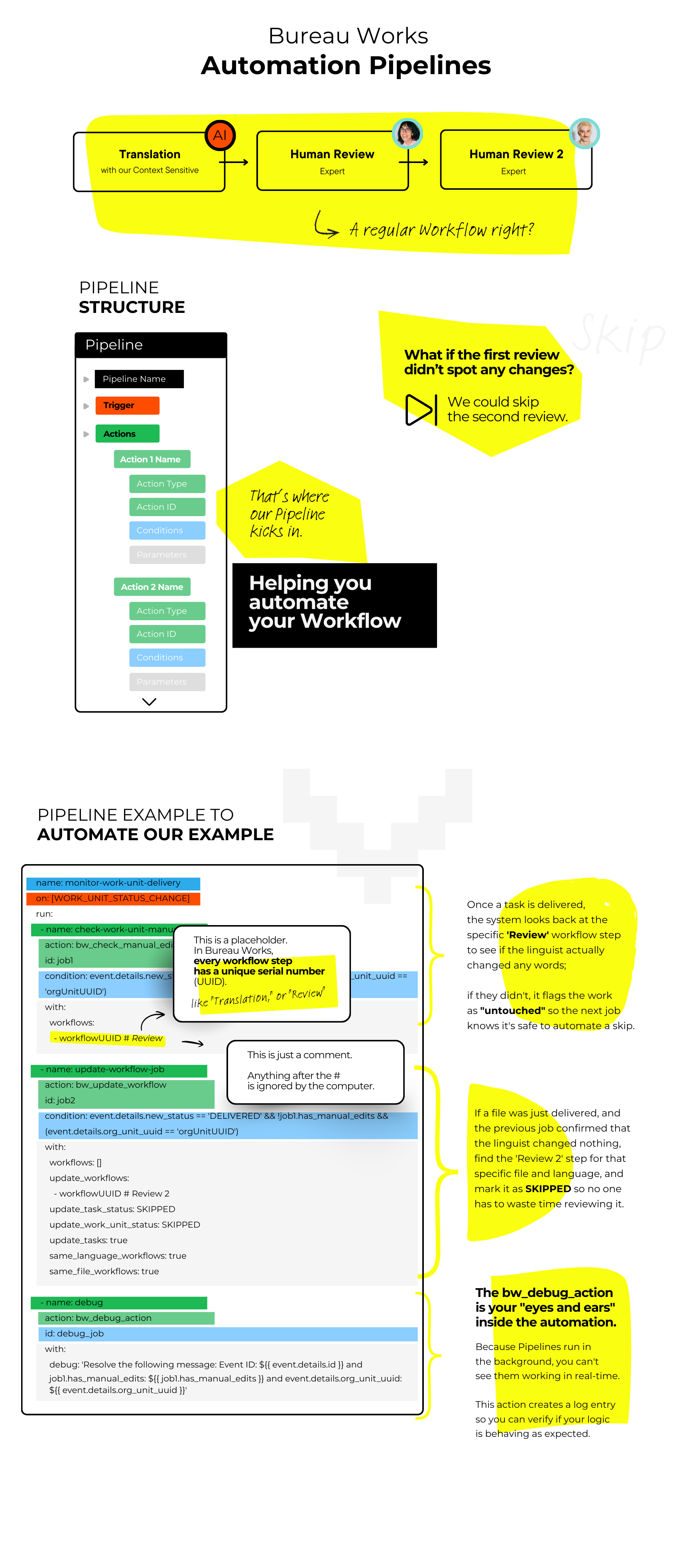
Pipelines let you put all of that into practice. Think of them as if this, then that rules for your workflow. Instead of clicking through every stage, you define what should happen and when.
Setting things up is simple. You just chain together Actions using a lightweight text format. And for the serious stuff, we added Secrets to keep API keys and private data encrypted and safe.
Check our Infographic below and also access our Pipeline documentation here.
What If You Could Fit 500 Documents on One Table?
Earlier, we mentioned how for almost 5,000 years translators worked with the source document and the translation side by side.
Now imagine taking that same way of working and scaling it to 500 documents at once.
All on the table.
- Search across everything.
- Apply repetitions everywhere.
- Update a glossary once and see it reflected across all of them.
That would sound completely insane. And until recently, it kind of was. You can now open up to 500 work units at once, joined directly in the editor. No more breaking projects apart just to make the tool behave.
We also improved performance behind the scenes. Even with joined work units, the editor stays fast and responsive, supporting up to 50,000 segments in a single view.
The same ancient workflow. Just at modern scale.
Unlock the power of glocalization with our Translation Management System.
Unlock the power of
with our Translation Management System.


.png)
.png)
.png)
.png)

.png)
.png)
.png)
.png)
.png)